

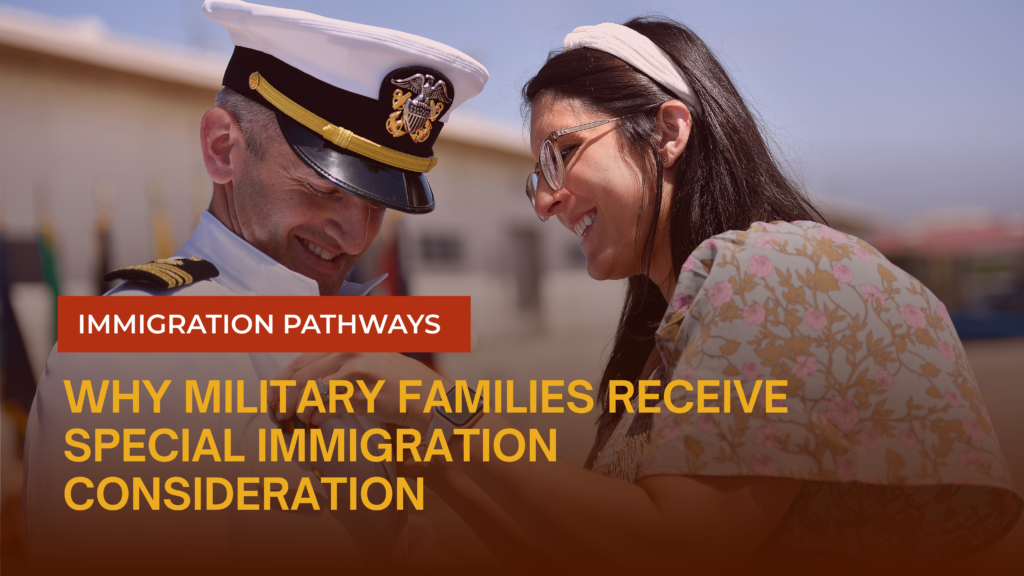
Understand the unique protections, priorities, and responsibilities that apply to military-connected immigration cases.
As foreign-born military spouses, we live between two mindbogglingly complex systems: U.S. immigration law and military life. Each system can feel overwhelming on its own. But together, they can create confusion, fear, and prolonged uncertainty for families who are already sacrificing so much in service to the nation.
Here’s the good news: you are not invisible. 25% of military spouses are foreign-born. The U.S. government and immigration agencies recognize the importance of family stability for service members and provide special immigration considerations designed to protect family unity, military readiness and morale. Understanding these benefits can make a critical difference in your case.
We’re here to help you understand these protections and take the first step toward advocating effectively for your family!
Why Does The Government Prioritize Military Immigration Cases And What Does That Mean For You?
Immigration uncertainty can weigh heavily on service members and military families. Worrying about a spouse being separated, delayed, or at risk of deportation takes a real toll on focus, morale and readiness. Simply put, it’s hard to stay mission-ready when immigration paperwork is keeping you up at night.
To avoid this, immigration agencies are instructed to:
-
- Expedite cases involving active-duty service members
-
- Apply flexible standards where allowed by law
-
- Prevent family separation whenever possible
In real terms, this means immigration cases that often take 12–18 months for civilian families may be processed in 1–3 months for military families — when handled correctly and depending on the circumstances of each case.
That said, these benefits are not automatic, and faster processing is never guaranteed.
The Most Common Mistake Military Families Make
One of the most common, and costly, mistakes military families make is assuming the government will “see” their military status without being told.
Immigration officers process thousands of applications every week. If your service member’s military service is not clearly identified and documented, there is a good chance your case may be treated as a standard civilian case. So make sure you clearly highlight their active duty status in your application.
Ensure your immigration filing includes:
-
- A copy of the service member’s military ID
-
- Active-duty orders, deployment orders, or PCS orders
-
- A short cover letter stating that the case involves an active-duty service member
Failing to include this documentation can result in:
-
- Longer processing times
-
- Requests for Evidence (RFEs)
-
- Missed opportunities for expedited review
Key takeaway: Military consideration only applies if you present it clearly.
Financial Requirements: A Critical Military-Specific Benefit
Family-based immigration requires the U.S. citizen sponsor to prove that their spouse will not become a “public charge” (dependent on government assistance).
For civilian families, the income requirement is 125% of the federal poverty guidelines.
For active-duty military families, the requirement is reduced to 100% of the poverty guidelines.
This distinction exists because military compensation often looks lower on paper while excluding:
-
- Housing allowances
-
- Healthcare benefits
-
- Commissary and base access
-
- Education and family support benefits
Unfortunately, this reduced threshold is often applied incorrectly if your service member’s military status is not clearly documented.
Always include proof of your service member’s active-duty status to ensure the correct standard is used.
Expedited Processing: What It Really Means
“Expedited” does not mean automatic approval. It can mean:
-
- Faster case review
-
- Priority placement in processing queues
-
- Reduced waiting periods between steps
Military families may receive:
-
- Faster USCIS petition approvals
-
- Accelerated consular interviews abroad
-
- Priority scheduling for biometrics
That said, accuracy matters. Incomplete or incorrect applications can slow things down, sometimes more than standard processing.
Why This Matters for Foreign-Born Military Spouses
Foreign-born spouses often face additional barriers beyond paperwork:
-
- Language challenges
-
- Cultural misunderstandings
-
- Fear of authority due to experiences in home countries
-
- Isolation from extended family support
-
- Limited access to trustworthy legal guidance
Understanding that your family is recognized and that protections exist, helps shift your mindset from fear to confidence.
You are not asking for special treatment.
You are accessing protections that exist because of your family’s service.
Key Immigration Challenges and Considerations for 2026
As immigration policies continue to evolve, we have compiled key developments affecting immigration cases for foreign-born military spouses and fiancés to keep you informed:
-
- There are currently no instances of waived or simplified interview requirements – military and civilian applicants alike should expect to be called to the required interviews.
-
- Although cases involving military families are typically eligible for expedited processing, we are currently observing longer processing times and increased delays across cases.
What You Should Do Right Now
If you are beginning or already in an immigration process:
-
- Gather all military documentation (i.e. copy of your service member’s PCS orders and Military ID)
-
- Ensure your service member’s active-duty status is referenced in every filing
-
- Keep copies of everything submitted
-
- Seek legal guidance if your situation includes complications
Helpful Resources for Military Families
-
- USCIS Military Help Line:
 877-247-4645
 https://www.uscis.gov/military
- USCIS Military Help Line:
-
- Military OneSource – Immigration Support: https://www.militaryonesource.mil
- Military OneSource – Immigration Support:
-
- American Immigration Lawyers Association (AILA) – Military Assistance Program: https://www.aila.org/library/military-assistance-program
- American Immigration Lawyers Association (AILA) – Military Assistance Program:
-
- Department of Defense Legal Assistance Offices: https://legalassistance.law.af.mil
- Department of Defense Legal Assistance Offices:
-
- Foreign-Born Military Spouse Network (FMSN):
Community support, education, and referralshttps://fbmnetwork.com/
- Foreign-Born Military Spouse Network (FMSN):
Final Thought
Do not let the immigration process intimidate you! With the right information and preparation, you can move forward with clarity, confidence, and peace of mind.
How FMSN Can Help
You don’t have to navigate this alone! The Foreign-Born Military Spouse Network (FMSN) provides:
-
- Education and plain-language guidance from an experienced Immigration Coordinator
-
- Trusted referrals to military-informed legal support
-
- Community spaces where spouses can ask questions safely
 Need help understanding your immigration options?
-
- Complete our Intake Form and a member of our team will reach ou to you
-
- Email us at info@fbmnetwork.org
If you are looking for more information on Immigration Law and Visa Processes for foreign-born military spouses (and fiancés!), watch our full conversation with Immigration Attorney Nadezda Roife here.
Disclaimer: Last Updated – January 2026 | The information in this guide is for educational purposes only and does not constitute legal advice. Immigration laws and policies change frequently. Consult with a qualified immigration attorney for guidance specific to your situation.